
Ducati Scrambler Cafe Racer: Factory Models and Custom Builds
The references listed below support the regulatory, safety, and manufacturer statements in this guide. Any dollar figure is an editorial planning estimate based on typical scope, not a quote and not taken from those references, unless a current official price is explicitly cited at that point in the text. Confirm fitment, safety, legality, availability, and current pricing for your exact vehicle before you buy or commission work.
A Ducati Scrambler cafe racer can be a factory Café Racer, a Nightshift with cafe-style details or a custom conversion. Start by identifying the model and generation, then decide which parts of its appearance and riding position you actually want to change.
This guide focuses on the modern Scrambler 800 family. The Sixty2 and Scrambler 1100 need their own parts checks. Use the Ducati Scrambler builder directory and build-brief creator once you have a donor and a defined scope.
Factory Cafe Racer, Nightshift or Custom Build?
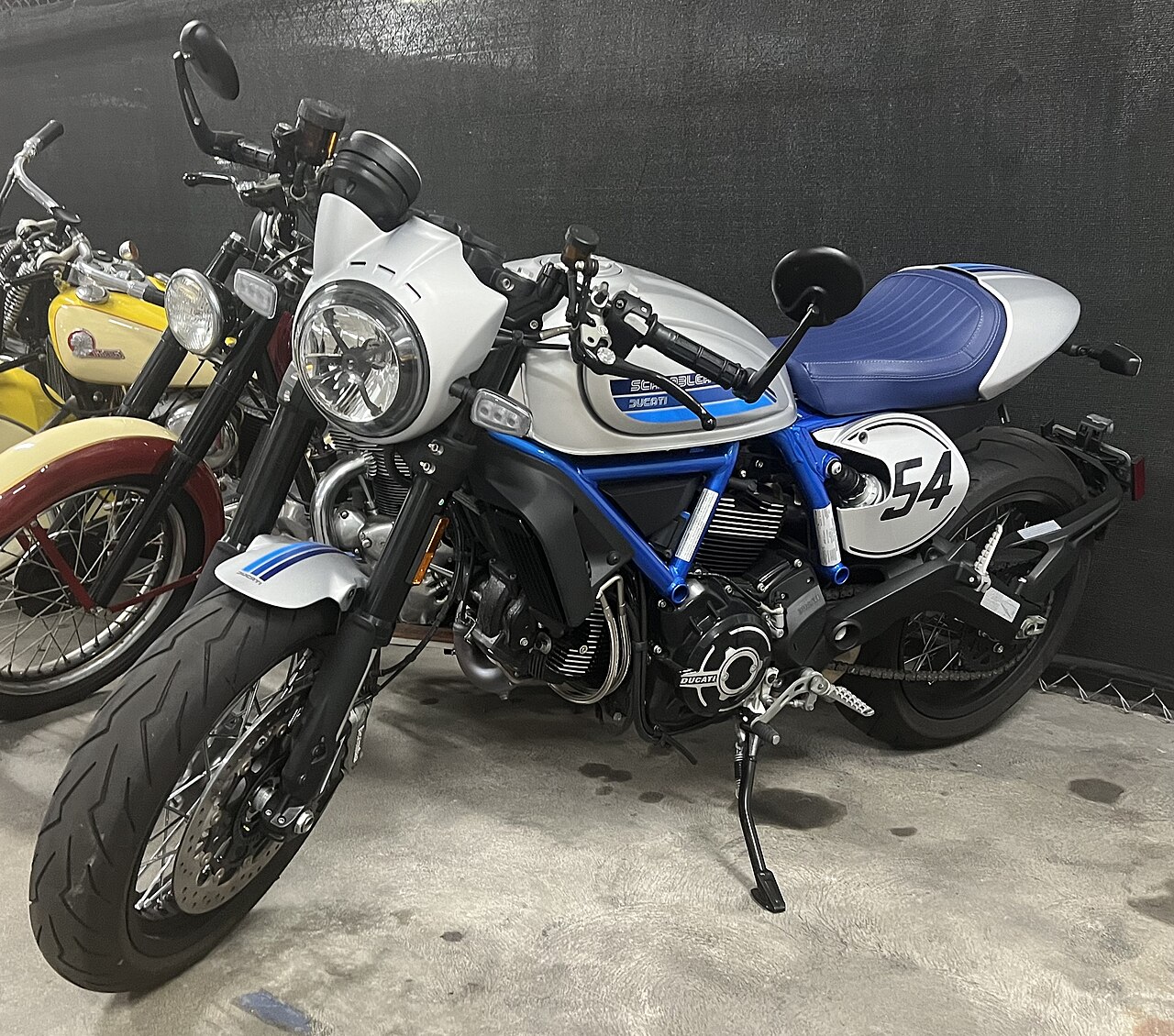
A Ducati Scrambler Cafe Racer photographed at the Petersen Automotive Museum. This factory-model reference is separate from the South Garage and deBolex customs in this guide.
Ducati Scrambler Cafe Racer at the Petersen Automotive Museum by TaurusEmerald · CC BY-SA 4.0. Resized by Wikimedia; no crop or other editorial edits.

A factory model provides a reference for the complete design. A custom project shows what a particular builder changed. Keep those roles separate when comparing photographs or planning a parts order.
| Starting point | What the factory records establish | What it means for your project |
|---|---|---|
| Original factory Café Racer, introduced for 2017 | A named production member of the Scrambler family, distinct from a shop-built conversion. | Identify the exact year and factory equipment before replacing parts. |
| Updated 2019 US Café Racer | The US launch announcement includes cornering ABS, a hydraulic clutch and updated lighting/instruments across the refreshed Scrambler 800 family. | A 2017-era parts description alone is not a complete compatibility check. |
| Second-generation Icon, Full Throttle or Nightshift, introduced for 2023 | Ducati describes revised chassis and bodywork, a separate rear frame, ride-by-wire and a TFT display. | Treat earlier tail, tank-cover, control and wiring parts as unconfirmed fitments. |
| 2026 Nightshift | Ducati specifies an Emerald Green finish, a stitched cafe-style seat, straight handlebars, bar-end mirrors and black spoked wheels. | Compare its existing equipment with your desired riding position before planning changes. |
| CR24I | Ducati presented this second-generation cafe-racer interpretation as a concept in May 2024. | That announcement does not establish a production model or a retail conversion kit. |
The distinctions come from Ducati's 2017 model and custom-show account, 2019 US model announcement, 2023 generation launch, 2026 Nightshift announcement and CR24I concept presentation.
The Nightshift name also spans an earlier generation. Check the year and VIN rather than identifying a motorcycle only by its trim name or paint color. A factory Café Racer, a Nightshift and an Icon conversion should each have a parts list matched to the actual bike.
Two Documented Scrambler Customs
South Garage Essenza
Ducati's January 2017 Motor Bike Expo report identifies Essenza as a South Garage project with a cafe-racer direction. The account emphasizes craftsmanship and finish while describing a design that avoids intrusive changes to the frame or suspension.
Essenza is a useful reference for discussing a cohesive finish and silhouette without assuming a complete chassis conversion. The article does not publish a transferable parts kit or an exact donor year. Use its original photographs to explain your preferred details, then have the builder specify the work for your own motorcycle.
deBolex's 803cc TT-Style Scrambler
Ducati's Bike Shed London 2018 feature describes an 803cc Scrambler converted by deBolex with aluminum bodywork, including the fuel tank and fairing. It also identifies changes to the wheels, tires and suspension.
This is a substantial fabricated project. The same report describes a separate deBolex Scrambler 1100 with its own fairing, tail, top yoke and instrument relocation. Those 1100 details should not be assigned to the 803cc bike. Both are historical project examples; the feature does not establish current kit supply, street approval or a booking for your vehicle.
Follow the source links for the publishers' project photographs. The licensed factory-model photograph in this guide shows a separate motorcycle.
A Parts Listing Should Name the Model and Year
Ducati's Old Skool Checkerboard bodywork listing, code 97181591AB, gives a concrete example. At review, its compatibility list named the Icon for 2023, 2024, 2025 and 2026, plus the 2025 10° Anniversario Rizoma Edition. It did not list the earlier factory Café Racer or Nightshift.
This is a decorative bodywork package for the named applications. It does not turn an older Scrambler into a complete cafe racer, and its fitment list should not be extended to other trims without confirmation. Ask a dealer to check your VIN, the current part number and the assembly instructions before ordering.
Apply the same discipline to aftermarket seats, rearsets, brackets and lighting. Record the supplier, part number, supported year and variant, included hardware, required modifications and return terms. A product photograph alone cannot answer those questions.
Plan the Conversion as One Assembly
| Work area | Decide before buying | Ask the installer to check |
|---|---|---|
| Bars and mirrors | Desired reach, bar height and mirror position | Tank clearance, controls, hoses and full steering movement |
| Seat, cowl and tail | Passenger use, seat access and the parts to retain | Latch and bracket fitment, tire clearance and lighting mounts |
| Fairing and headlight | Shape, mounting method and instrument position | Steering movement, lamp mounting, wiring access and service access |
| Foot controls | The riding position with the proposed bars and seat | Linkages, brake-light operation and mounting compatibility |
| Paint and finishing | Materials, repair areas, color samples and artwork | Preparation, trial fitting, outside suppliers and reassembly |
| Exhaust and electronics | Exact system, existing modifications and intended use | The supplier's application, required supporting work and an agreed testing scope |
The 2023 redesign makes these checks especially relevant: Ducati describes changes to the rear frame, tank covers, instruments and electronic throttle. A seat or control package designed around an earlier bike should be checked as a complete installation.
Before final paint, ask to see the panels, controls, seat and lighting fitted together. Keep access to routine service points in the design. If several businesses are involved, agree who owns final assembly and who resolves a component that does not fit.
Budget for the Donor and the Complete Job
Begin with the motorcycle's condition, service records and previous modifications. Ask a Ducati-experienced workshop to identify baseline work before committing the remaining budget to styling.
Request separate quote lines for inspection, purchased components, fabrication, wiring and controls, surface preparation, paint or upholstery, mechanical work and final assembly. Identify shipping and outside-specialist charges. Agree on an approval step after disassembly or trial fitting reveals additional work.
The Essenza and deBolex features do not provide a representative US conversion price. A bodywork-package price would also omit most of the work in a fabricated build. Put your donor details, preferred design, passenger needs and spending limit into the Scrambler project brief and ask shops to quote the same scope.
For finishing work, the reviewed motorcycle paint cost guide explains how to compare dated provider prices and their inclusions. Use those examples to frame questions about your panels, rather than treating them as a whole-bike conversion quote.
Choose a Builder with Relevant Evidence
Use the Scrambler directory to find profiles, then ask for completed work on the same generation and systems as your donor. Confirm who will make the brackets or panels, handle electrical changes, apply the finish and assemble the motorcycle.
The fabrication, paint and upholstery directories can help when your project has a narrower scope. Their reviewed entries identify the work supported by linked sources; confirm the exact service and current intake directly with the business.
Ducati Scrambler Cafe Racer Questions
Is a Nightshift the same as the factory Cafe Racer?
They are separate factory variants. The 2026 Nightshift announcement describes straight handlebars and a cafe-style seat, among its other features. Identify the exact trim and year when choosing controls, bodywork or a donor.
Will a 2017 Cafe Racer seat fit a 2023 Scrambler?
Do not assume it will. Ducati documents chassis and rear-frame changes for the 2023 generation. Ask the supplier to confirm the seat, latch, brackets and surrounding panels for both the part and the intended motorcycle.
Does a cafe conversion require cutting the frame?
The reviewed examples show different approaches. Ducati describes Essenza without intrusive frame or suspension work, while the deBolex 803cc project involved extensive fabricated bodywork. Have the shop explain the mounting plan and any structural work before approving a design.
Can the CR24I concept be ordered as a kit?
The cited 2024 announcement presents CR24I as a Ducati design concept and does not offer a retail kit. Use it as inspiration and request an actual parts list or build proposal for your donor.
Sources Checked
Reviewed September 14, 2026. Factory models, supplier fitment lists and historical custom projects are attributed separately. The licensed photograph is credited at the image and does not establish the specification of either custom project.