
Honda CB750 Cafe Racer Guide: SOHC, DOHC and Documented Builds
The references listed below support the regulatory, safety, and manufacturer statements in this guide. Any dollar figure is an editorial planning estimate based on typical scope, not a quote and not taken from those references, unless a current official price is explicitly cited at that point in the text. Confirm fitment, safety, legality, availability, and current pricing for your exact vehicle before you buy or commission work.
A Honda CB750 cafe racer can start from several different generations of motorcycle. The original SOHC four, the later DOHC CB750F and the 1990s CB750 family need separate donor and parts checks. Start with the exact year, market and submodel, then define the riding position and finished bike you want before buying a conversion kit.
This guide pairs real photography with documented projects and a practical build sequence. Use the separate Honda CB750 builder directory to find relevant shop profiles, and bring photographs and a written scope when you ask about a commission.
CB750 Cafe Racer Inspiration
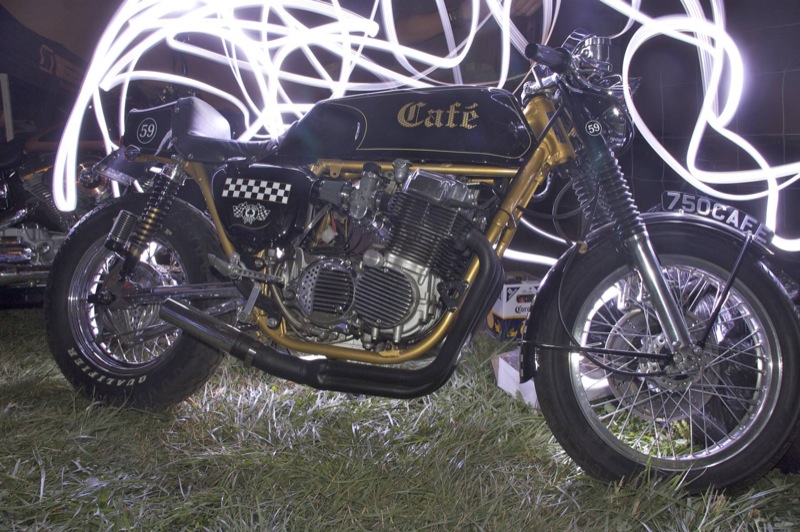
Honda CB750 cafe racer photographed in 2008. The builder, donor year and components are unrecorded. This is a separate motorcycle from the named projects below.
Honda CB750 Cafe Racer 59 by Tristan Brand · CC BY 2.0. Uncropped; no editorial edits.

The pictured custom combines a black tank and tail, gold frame and wire wheels. Use references like this to explain proportions and finishes to a builder. Ask for photographs of its own completed motorcycles, including the controls, seat mounts, wiring access and other details that a single overall view cannot establish.
SOHC And DOHC: Identify Your Donor
SOHC means single overhead camshaft; DOHC means double overhead camshaft. These terms help identify the engine family, but they do not confirm that a tank, seat, fork or exhaust will fit. Honda's model history provides useful reference points for the different generations.
| Factory reference | Engine family | What to check |
|---|---|---|
| 1969 Dream CB750 Four | Original overhead-cam four | Identify the exact early model and existing chassis; do not buy from the CB750 name alone. |
| 1979 CB750F | DOHC four | Match the later engine and complete submodel, including the fitted wheels and brakes. |
| 1992 CB750 | Later air-cooled DOHC four | Establish the market and model designation before treating it as interchangeable with an older F or K. |
These are historical model examples, not a complete production or interchangeability chart. Record the frame identity, engine identity, production information and known modifications. Compare those details with the parts supplier's documentation. A registration year or a seller's description may not explain which components are actually fitted.
Two Documented CB750 Builds
Each project below has a published specification and an original gallery or build presentation. The listed parts describe that specific motorcycle. They are useful discussion points for your own design, not a universal shopping list.
Cognito Moto Goldie: 1974 SOHC
Cognito Moto identifies Goldie as a 1974 CB750 with a GSX-R 750 front end, its conversion stem and bearing setup, dual 310 mm rotors and Tokico four-piston calipers. The shop describes rebuilding the 736 cc engine to factory specifications, then adding its oil tank and airbox, electronic ignition and Motogadget electronics. Goldie build specification and presentation.
This example shows why a front-end change should be quoted as an assembled system. Ask who checks the stem, bearings, wheel, brakes, controls and clearances together. The builder's statements about its finished motorcycle do not establish the result of fitting similar-looking parts to a different donor.
Kaspeed Moto: 1996 Seven Fifty
Honda's 2018 feature identifies Kaspeed's donor as a 1996 CB750 Seven Fifty. The documented changes include a carbon-Kevlar tail, a handmade leather solo seat, Öhlins shocks, LSL clip-ons, Kellermann indicators, a KOSO LED headlight and a LeoVince stainless exhaust. Honda's Kaspeed build feature and photographs.
Use this later-generation example to discuss the relationship between tail shape, upholstery, controls and suspension. The original feature provides a design reference and named components; confirm present-day parts availability and suitability with the builder or supplier.
What Does A CB750 Cafe Racer Kit Actually Fit?
Ask for a list of every included component and the exact years and submodels supported. Separate a seat or oil-tank kit from a complete motorcycle conversion. Check whether the offer includes brackets, hardware, electrical work, finish work and installation, and which original components it expects you to retain.
For example, Cognito Moto lists its replacement oil tank for 1969 to 1978 SOHC CB750s and notes additional work at the original hose clamp. That fitment statement does not extend to the DOHC bikes in the table. Cognito's CB750 oil-tank fitment notes.
Send the supplier photos and the full donor identity before ordering. Ask your builder to review the parts list as a whole, including work the kit does not cover. If the engine, frame or front end has already been changed, include those details in the request rather than relying on the bike's original model label.
Plan The Build In Stages
Ask for an approval point after diagnosis and another after the physical mock-up. This gives you a chance to understand newly discovered repairs and design changes before spending on the final finish. If preservation matters, ask the builder to describe a version that keeps the original frame and bodywork intact.
Build A Budget From The Scope
The project features above do not provide a representative US price for a CB750 conversion. Keep the donor purchase, inspection, required repairs, purchased parts, fabrication, electrical work, finishing and assembly as separate lines in your budget. Ask whether transport, shipping and other applicable charges are included.
Have each shop quote the same donor and intended result. Identify which figures are fixed, which are allowances and which will be billed by hours. Agree on how additional work is documented and approved. A lower opening figure is difficult to compare if it omits repairs that another shop has already included.
For specific services, use the motorcycle paint price guide and dyno tuning cost guide. Their published examples belong to particular services and providers; they do not add up automatically to the cost of your CB750 build.
Choose A Builder With Relevant Evidence
Start with Honda CB750 shop profiles and the existing Cognito Moto profile. Ask for a project from the same generation, what the shop performed itself, which work went to specialists and whether it currently accepts the scope you need. A business selling conversion parts may offer a different service from a shop taking complete commissions.
Use the build brief creator to record your donor, current condition, intended use, preferred style, budget ceiling and timing. Add photographs and your proposed parts list when contacting the shop. The useful next step is a discussion about your actual motorcycle and the work the builder can document.
Sources Checked
Reviewed September 10, 2026. Factory references and project specifications are attributed to their publishers. The licensed photograph is credited separately and is not evidence of the components fitted to either named build.